The EU in Search of Visions

By Events

The Ninth Bosphorus  Summit took place between November 25-28,  2018 at the Four Seasons’ Bosphorus Hotel in Istanbul.  The program can be found at  https://www.bogazicizirvesi.org/files/9.BZ_Program_Tr-26112018-v1.1.pdf . One of the many panels organized concerned the EU and was entitled The EU in Search of Visions. The panel was organized and moderated by Turabder’s president Prof. Dr. Gül Günver Turan.

THE EU IN SEARCH OF VISIONS

November 27 , 2018 (14:00 – 15:00) (ROOM B)

KeynoteSpeakers 

Amb. Faruk Kaymakçı, Deputy Minister of Foreign Affairs & Director for EU Affairs, Turkey

Amb. George Ciamba, Minister of EU Affairs, Romania

Moderator: Prof. Dr. Gül Günver Turan, President, TURABDER, Turkey

Panelists

Prof. Dr. Sanem Baykal, Faculty of Law, Ankara University, Turkey

Metin Gürcan, Co-founder , Episteme, Turkey

Nilgün Arısan Eralp, Center Director, TEPAV, Turkey

Nora Neuteboom, Economist, ABN AMRO’s Group Economics, The Netherlands

Federal Assembly Meeting ( November 9, 2018, Vienna)

By Events

Once a year, member organisations of the European Movement International network gather for our Federal Assembly to discuss the state of the organisations, debate the big issues that face Europe, as well as set a course for the organisation to follow in the year ahead.

This year, the Federal Assembly will take place on 9 November in Vienna and it is co-hosted by the EM International and the EM Austria.

All member organisation have the right to be represented by their leadership (or appointed delegates). The EM International Board also meets at the margins of the FA, as do the Political Committees.


Borders for Migrants-Limitations

By Events

The Kartepe Summit Organization, hosted by the Republic of Turkey Kocaeli Metropolitan Municipality has this year organized a three day symposium on “Migration, Refugees and Humanity”. The program can be found at https://www.kartepezirvesi.com/kartepe-summit-2018. The president of TURABDER was the chair of the Panel entitled Borders for Migrants-Limitations and the participants were

Prof. Dr. Ilias ILIOPOULOS
Atina University

Dr. Elizabeth CHALLINOR
Uminho- Universidade Do Minho

Prof. Dr. Eric TRINKA
The Catholic University Of America

The video of the panel can be found at https://youtu.be/NFiA4_zregg or IFrame

Differing Views on Turkey-EU Engagement

By Events

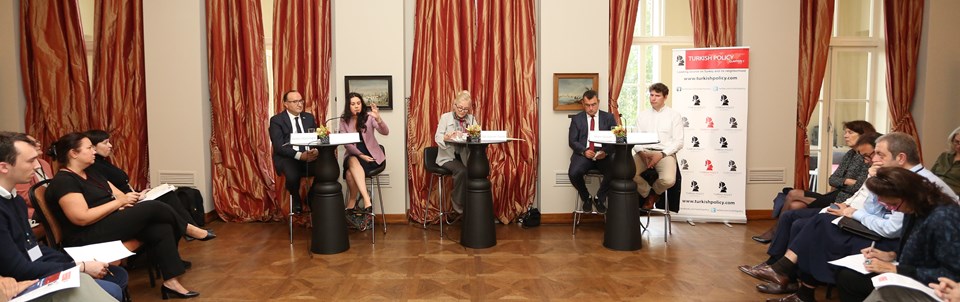
The Turkish Policy Quarterly (TPQ) organized a roundtable on Turkey-EU Relations which took  place on Tuesday, October 9th at the Netherlands Consulate at the Palais de Hollande. The topics of the panel moderated by TURABDER’s president included key issues on the agenda: visa exemption for Turkish citizens, updating the Customs Union, security cooperation, and maintaining a constructive dialogue on Turkey’s reform agenda. The program was as follows

Program:

5:00-5:30pm – Registration

5:30-5:40pm – Opening Remarks by Marjanne de Kwaastenietthe Ambassador of the Kingdom of the Netherlands to Turkey

5:40-7:00pm – Panel Presentation

7:00-7:30pm – Q&A Discussion

Moderator:

Gül Günver Turan, President, Turkey-European Union Association

Speakers:

Ayhan Zeytinoğlu (TBC), President, Economic Development Foundation

Zümrüt İmamoğlu (TBC), Chief Economist, TÜSİAD

Metin Gürcan, Researcher, Istanbul Policy Center

Samuel Vesterbye, Managing Director of ENC

Turkey : Economic Outcome and Elections : Interview with Dimitri Bettoni from OBCT

By Diğer, Other

You will find below the original interview done by Dimtri Bettoni with Turabder’s President Gül Günver Turan which was later on shortened to fit the required 10.000 characters. The final interview can be found on the website of the Ossevatorio Balcani e Caucaso Transeuropa. (https://www.balcanicaucaso.org/eng/Areas/Turkey/Turkey-Economy-and-Elections-188693

Turkey’s Current  Economic Situation.

What are the current strenghts and weaknesses of the Turkish economy?

The following traits stand out when looking back at recessions and financial crises the Turkish economy have gone through in the past: Resilience characterized by a readiness for revitalization, recuperation, and recovery. Add to these a strong belief in the future, strong enterpreneurial spirit, a business friendly environment, readiness to use new technologies, an energetic workforce, close family ties allowing for support systems to operate, all allowing  recovery to be more rapid than expected. This ability to withstand and cope with shocks, this bouncing back is unfortunately hampered today by vulnerabilities, weaknesses  caused by  both external and internal economic shocks. These shocks are not only a result of intrinsic features of Turkey’s economy but are also due to a lack of good governance and sound macroeconomic management.

Turkey is an export oriented economy easily affected by external shocks such as sudden drops in foreign demand. Its domestic economy is dependent on strategic imports such as gas, oil and raw materials whose prices are currently on the rise. The resulting current account deficit amounts to 57 billion dollars between March 2017 and 2018. Low domestic savings has led to high dependency on foreign savings. Foreign direct investments and portfolio investments are not as high as may have been wished, constituting a major problem at a time when  repayment of foreign debt in 2018 amounts to 240 billion dollars, To make things worse,  domestic capital outflow has increased while Turkish firms operating abroad have become more reluctant to send their earnings back to Turkey.  Shortage of hard currency is also exacerbated by the perception by both domestic and foreign actors that there is a weakening of the rule of law and deterioration of the judicial processes.

How can  the weakness of the lira be explained

The weakness of the TL can be explained by the large amount of foreign debt, an increasing current account deficit, low rates of foreign direct and portfolio investments and fear of the future while the Central Bank remains dormant.  Article 4, part II of the Law on the Central Bank of Turkey entitled defining the “Fundamental Powers of the Bank” stipulates that  the Bank, with the objective of maintaining price stability, shall be authorized to use monetary policy instruments described in this law and also determine and implement other monetary policy instruments that it deems appropriate. De jure the Central Bank is independent but de facto it has taken its clues from President Erdoğan who favors the lowering of interest rates.  His insistence that inflation is a result of high interest rates and therefore interest rates should be lowered has accelerated the run on the currency.  At a time when there is an increasing demand for foreign exchange and interest rates are below inflation rates, the logic of economics would dictate a rise rather than a drop in the interest rates.

The Central Bank raised the interests twice last weeks. Why precisely now?

And what did President Erdogan mean when he spoke about bringing monetary policy more under the government’s control? With what consequences?

It is only when the  TL  hit a record low of 4.9290 against the US dollar that the Central Bank finally decided on tightening monetary policy and raised interest rates. The President’s recent declaration that he would take greater control over monetary policy after the presidential and parliamentary election has once again speeded the selling of TL holdings, but the Central Bank’s determined stand and its increasing of rates a second time have helped a modest recovery of the TL. How long lived this will be we shall have to see… The trend is presently upward. After all, the fever (inflation) is not yet down but at least the termometer (interest rate) is now allowed to show how high this fever is. Can we attribute any logical meaning to what was said by the President during a political rally? It is as if he wished exchange rates to skyrocket again…It may be that he was misguided by his personal economic advisors who thought that Neofisherism could apply to Turkey, characterized by an overheated economy with high rate of inflation and in great need of foreign exchange.

How has this affected the economy?What part of the Turkish society is at the moment suffering the most and what part is gaining advantages

The burden of businesses who had contracted foreign debt denominated in dollars or euros has now increased. The State itself faces the same problem when repaying public debt. Export and imports can both be negatively affected by the depreciation of the TL since the exchange elasticity is negative.  Gas, oil and raw material imports have become more expensive which will fuel even more inflation in the coming months.

A report published by DISK ( Confederation of Progressive Trade Unions of Turkey entitled “Labour under the AKP” emphasizes that trade union rights were violated, strikes prohibited, social security benefits reduced, income distribution deteriorated unfavorably against workers, unemployment grew, the tax burden of workers has increased as indicated by the share of indirect taxes in total taxes going up to 65% in 2017. We can therefore say that the income of Turkey’s low income groups have not improved. Any winners? These days, there seem to be more losers than winners  except for those who held their earnings and savings in gold and/or  foreign exchange.

Why is the government insisting so much in pursuing economic growth despite its high costs in term of inflation and the loss of value of the currency?

The insistence is due to the obligation the President feels to realize the Vision 2023 plan he had made public in 2011. The vision consists of a list of economic, political and social goals  to be achieved by 2023, the centennial of the Republic. The major economic goals were to move up Turkey from a middle income to a high income country with a GDP per capita of 25,000 dollars, allowing Turkey to become the 10th largest economy in the world, tripling its exports to 500 billion US dollars, develop ten globally recognized Turkish brands  and complete accession negotiations with the EU.

Although Turkey has a well functionning market economy and has achieved a strong growth in 2017 coupled unfortunately with high current account deficit and double digit inflation, it is far from achieving these goals.  The  spectacular growth attained so far is unsustainable since it was realized mainly by government guarantees encouraging loan expansion, by tax incentives and by boosting private consumption. This policy has simultaneously fueled imports of consummer goods.  We are in an election year and the government, naturally wishing to win the elections, can not afford to tell its constituencies that this growth is only temporary and that inflation can only be controlled if growth rates are lowered. Ensuring sustainabilitiy of high growth rates can only be achieved with higher domestic saving rates, higher investments and less dependency on foreign capital inflows.

President Erdoğan also  voiced the possibility of the creation of a national rating agency. How would you evaluate this move?

In March 2018 the Head of the Banking Regulation and Supervision Agency (BDDK), at a press review also talked about the establishment by Turkish banks of such a  credit rating agency which would become operational within a few years. Would such a national agency be truly independent, impartial and in compliance with international standards, would it be trusted by international investors it its reports contradict those prepared by international rating agencies, I seriously doubt it.

 Is Erdogan consciously putting Turkey’s economy in a dire situation in order to pursue an ideological agenda that aims at severing the bonds with the West?

I do not think that this is his current agenda. He has realized now that not much can be achieved by siding up solely with the sunni Arab world, that Russia by itself is not a reliable party, that China has still a long way to go and that Africa is still too small a market. He also realizes how costly it can be to severe bonds with the West since 70% of foreign direct investments comes from the EU, since around 50 % of trade is conducted with it, and since recent polls indicate that more than 78 % of the Turkish people wish for the continuation of accession negotiations with the EU. Authoritarian leaders have a tendency to behave alike. Look at Trump who follows a selfish nationalistic agenda with no consideration for others including its close allies, but who will change sides and views when necessary. Opportunistic behaviour is a characteristic of the political arena in the comtemporary world.

Early Elections and the Future of Turkey

Were early elections called in by the government as an attemp to secure the control over the state before Turkey enters the storm of an economic crisis?

Parliamentary and presidential elections were supposed to take place in November 2019 with local elections taking place earlier, in March 2019. Polls showed a decline in the support for the AKP and the popularity of the President while economic indicators gave signs of a turbulence which would require drastic contractionary policies. To mitigate these fallouts, the President announced that early elections would be held on June 24. If the coalition formed by the AKP (Justice and Development Party) and MHP (Nationalist Action Party) wins the election, the constitutional referendum passed last year will allow them to move to a presidential system where the president’s power is increased, the prime ministry and council of ministers is eliminated and the powers of the parliament weakened.

How and why were electoral coalitions formed and did any of the candidates propose something you consider meaningful and appealing during this electoral campaign?

The polls indicated that the MHP might not pass the 10% national electoral threshold after the party split into two with the newly formed IYI Party (Good Party)  under Meral Akşener becoming more popular than Mr. Bahçeli’s MHP. To counter this development, the AKP passed a law enabling electoral alliances and formed  the Republic Alliance with the MHP. To their great surprise, the opposition parties, though ideologically distant from one another, also formed an alliance called the Nation Alliance, the partners being two right wing parties  (IYI : Good Party and SP: Felicity Party) and one center left party (CHP: Republican Peoples Party). During elections voters will vote for the party of their choice and if the party they voted for is member of an alliance, the percentage of the total vote of the alliance parties will be used as the figure used in determining whether the electoral threshold has been reached,  allowing smaller alliance partners to pass the 10% threshold.

A tacit agreement appears to have been concluded between the parties forming the Nation Alliance also. During the first round of the presidential election, the supporters of these three parties will vote for the candidate of their choice. If no candidate gets more than 50 % of the vote, the competition goes to a second round between the two top runners. The Nation Alliance  parties have promised to rally behind the candidate of their partners who have made it to the second round. If the Nation Alliance wins, they promise to return to a parliamentary regime and to implement a radical democratization program.

What should be Turkey’s priorities in terms of economic reforms?

Difficult days await Turkey. The economy is in dire need of reforms and whoever wins the elections will be facing difficult problems and challenges. The Central Bank seems to have lost its credibility. It has acted too slowly to rein in  inflation and protect the TL.  The Treasury’s credibility is also in question. Turkey has become too dependent on short term external funds with maturation dates of less than a year. The other required political and economic reforms can be listed as follows:

  • Improvement of the judicial system
  • Bringing down inflation and interest rates below the 5% level
  • Promoting investments in high valued products and increase the share of high tech exports.
  • Promoting policies to increase investment in R&D
  • Increasing corporate and household saving rates.
  • Reducing bureaucracy and red tape

The list could be longer. Discussions in business and financial circles center on who will be responsible for the conduct of the economy after the elections. Presently none of the presidential candidates have disclosed the economy team they will be working with. Much await to be disclosed and done….

Turkey : Economic Outcome and Elections : Interview with Dimitri Bettoni from OBCT

By Other

You will find below the original interview done by Dimtri Bettoni with Turabder’s President Gül Günver Turan which was later on shortened to fit the required 10.000 characters. The final interview can be found on the website of the Ossevatorio Balcani e Caucaso Transeuropa. (https://www.balcanicaucaso.org/eng/Areas/Turkey/Turkey-Economy-and-Elections-188693

Turkey’s Current  Economic Situation.

What are the current strenghts and weaknesses of the Turkish economy?

The following traits stand out when looking back at recessions and financial crises the Turkish economy have gone through in the past: Resilience characterized by a readiness for revitalization, recuperation, and recovery. Add to these a strong belief in the future, strong enterpreneurial spirit, a business friendly environment, readiness to use new technologies, an energetic workforce, close family ties allowing for support systems to operate, all allowing  recovery to be more rapid than expected. This ability to withstand and cope with shocks, this bouncing back is unfortunately hampered today by vulnerabilities, weaknesses  caused by  both external and internal economic shocks. These shocks are not only a result of intrinsic features of Turkey’s economy but are also due to a lack of good governance and sound macroeconomic management.

Turkey is an export oriented economy easily affected by external shocks such as sudden drops in foreign demand. Its domestic economy is dependent on strategic imports such as gas, oil and raw materials whose prices are currently on the rise. The resulting current account deficit amounts to 57 billion dollars between March 2017 and 2018. Low domestic savings has led to high dependency on foreign savings. Foreign direct investments and portfolio investments are not as high as may have been wished, constituting a major problem at a time when  repayment of foreign debt in 2018 amounts to 240 billion dollars, To make things worse,  domestic capital outflow has increased while Turkish firms operating abroad have become more reluctant to send their earnings back to Turkey.  Shortage of hard currency is also exacerbated by the perception by both domestic and foreign actors that there is a weakening of the rule of law and deterioration of the judicial processes.

How can  the weakness of the lira be explained

The weakness of the TL can be explained by the large amount of foreign debt, an increasing current account deficit, low rates of foreign direct and portfolio investments and fear of the future while the Central Bank remains dormant.  Article 4, part II of the Law on the Central Bank of Turkey entitled defining the “Fundamental Powers of the Bank” stipulates that  the Bank, with the objective of maintaining price stability, shall be authorized to use monetary policy instruments described in this law and also determine and implement other monetary policy instruments that it deems appropriate. De jure the Central Bank is independent but de facto it has taken its clues from President Erdoğan who favors the lowering of interest rates.  His insistence that inflation is a result of high interest rates and therefore interest rates should be lowered has accelerated the run on the currency.  At a time when there is an increasing demand for foreign exchange and interest rates are below inflation rates, the logic of economics would dictate a rise rather than a drop in the interest rates.

The Central Bank raised the interests twice last weeks. Why precisely now?

And what did President Erdogan mean when he spoke about bringing monetary policy more under the government’s control? With what consequences?

It is only when the  TL  hit a record low of 4.9290 against the US dollar that the Central Bank finally decided on tightening monetary policy and raised interest rates. The President’s recent declaration that he would take greater control over monetary policy after the presidential and parliamentary election has once again speeded the selling of TL holdings, but the Central Bank’s determined stand and its increasing of rates a second time have helped a modest recovery of the TL. How long lived this will be we shall have to see… The trend is presently upward. After all, the fever (inflation) is not yet down but at least the termometer (interest rate) is now allowed to show how high this fever is. Can we attribute any logical meaning to what was said by the President during a political rally? It is as if he wished exchange rates to skyrocket again…It may be that he was misguided by his personal economic advisors who thought that Neofisherism could apply to Turkey, characterized by an overheated economy with high rate of inflation and in great need of foreign exchange.

How has this affected the economy?What part of the Turkish society is at the moment suffering the most and what part is gaining advantages

The burden of businesses who had contracted foreign debt denominated in dollars or euros has now increased. The State itself faces the same problem when repaying public debt. Export and imports can both be negatively affected by the depreciation of the TL since the exchange elasticity is negative.  Gas, oil and raw material imports have become more expensive which will fuel even more inflation in the coming months.

A report published by DISK ( Confederation of Progressive Trade Unions of Turkey entitled “Labour under the AKP” emphasizes that trade union rights were violated, strikes prohibited, social security benefits reduced, income distribution deteriorated unfavorably against workers, unemployment grew, the tax burden of workers has increased as indicated by the share of indirect taxes in total taxes going up to 65% in 2017. We can therefore say that the income of Turkey’s low income groups have not improved. Any winners? These days, there seem to be more losers than winners  except for those who held their earnings and savings in gold and/or  foreign exchange.

Why is the government insisting so much in pursuing economic growth despite its high costs in term of inflation and the loss of value of the currency?

The insistence is due to the obligation the President feels to realize the Vision 2023 plan he had made public in 2011. The vision consists of a list of economic, political and social goals  to be achieved by 2023, the centennial of the Republic. The major economic goals were to move up Turkey from a middle income to a high income country with a GDP per capita of 25,000 dollars, allowing Turkey to become the 10th largest economy in the world, tripling its exports to 500 billion US dollars, develop ten globally recognized Turkish brands  and complete accession negotiations with the EU.

Although Turkey has a well functionning market economy and has achieved a strong growth in 2017 coupled unfortunately with high current account deficit and double digit inflation, it is far from achieving these goals.  The  spectacular growth attained so far is unsustainable since it was realized mainly by government guarantees encouraging loan expansion, by tax incentives and by boosting private consumption. This policy has simultaneously fueled imports of consummer goods.  We are in an election year and the government, naturally wishing to win the elections, can not afford to tell its constituencies that this growth is only temporary and that inflation can only be controlled if growth rates are lowered. Ensuring sustainabilitiy of high growth rates can only be achieved with higher domestic saving rates, higher investments and less dependency on foreign capital inflows.

President Erdoğan also  voiced the possibility of the creation of a national rating agency. How would you evaluate this move?

In March 2018 the Head of the Banking Regulation and Supervision Agency (BDDK), at a press review also talked about the establishment by Turkish banks of such a  credit rating agency which would become operational within a few years. Would such a national agency be truly independent, impartial and in compliance with international standards, would it be trusted by international investors it its reports contradict those prepared by international rating agencies, I seriously doubt it.

 Is Erdogan consciously putting Turkey’s economy in a dire situation in order to pursue an ideological agenda that aims at severing the bonds with the West?

I do not think that this is his current agenda. He has realized now that not much can be achieved by siding up solely with the sunni Arab world, that Russia by itself is not a reliable party, that China has still a long way to go and that Africa is still too small a market. He also realizes how costly it can be to severe bonds with the West since 70% of foreign direct investments comes from the EU, since around 50 % of trade is conducted with it, and since recent polls indicate that more than 78 % of the Turkish people wish for the continuation of accession negotiations with the EU. Authoritarian leaders have a tendency to behave alike. Look at Trump who follows a selfish nationalistic agenda with no consideration for others including its close allies, but who will change sides and views when necessary. Opportunistic behaviour is a characteristic of the political arena in the comtemporary world.

Early Elections and the Future of Turkey

Were early elections called in by the government as an attemp to secure the control over the state before Turkey enters the storm of an economic crisis?

Parliamentary and presidential elections were supposed to take place in November 2019 with local elections taking place earlier, in March 2019. Polls showed a decline in the support for the AKP and the popularity of the President while economic indicators gave signs of a turbulence which would require drastic contractionary policies. To mitigate these fallouts, the President announced that early elections would be held on June 24. If the coalition formed by the AKP (Justice and Development Party) and MHP (Nationalist Action Party) wins the election, the constitutional referendum passed last year will allow them to move to a presidential system where the president’s power is increased, the prime ministry and council of ministers is eliminated and the powers of the parliament weakened.

How and why were electoral coalitions formed and did any of the candidates propose something you consider meaningful and appealing during this electoral campaign?

The polls indicated that the MHP might not pass the 10% national electoral threshold after the party split into two with the newly formed IYI Party (Good Party)  under Meral Akşener becoming more popular than Mr. Bahçeli’s MHP. To counter this development, the AKP passed a law enabling electoral alliances and formed  the Republic Alliance with the MHP. To their great surprise, the opposition parties, though ideologically distant from one another, also formed an alliance called the Nation Alliance, the partners being two right wing parties  (IYI : Good Party and SP: Felicity Party) and one center left party (CHP: Republican Peoples Party). During elections voters will vote for the party of their choice and if the party they voted for is member of an alliance, the percentage of the total vote of the alliance parties will be used as the figure used in determining whether the electoral threshold has been reached,  allowing smaller alliance partners to pass the 10% threshold.

A tacit agreement appears to have been concluded between the parties forming the Nation Alliance also. During the first round of the presidential election, the supporters of these three parties will vote for the candidate of their choice. If no candidate gets more than 50 % of the vote, the competition goes to a second round between the two top runners. The Nation Alliance  parties have promised to rally behind the candidate of their partners who have made it to the second round. If the Nation Alliance wins, they promise to return to a parliamentary regime and to implement a radical democratization program.

What should be Turkey’s priorities in terms of economic reforms?

Difficult days await Turkey. The economy is in dire need of reforms and whoever wins the elections will be facing difficult problems and challenges. The Central Bank seems to have lost its credibility. It has acted too slowly to rein in  inflation and protect the TL.  The Treasury’s credibility is also in question. Turkey has become too dependent on short term external funds with maturation dates of less than a year. The other required political and economic reforms can be listed as follows:

  • Improvement of the judicial system
  • Bringing down inflation and interest rates below the 5% level
  • Promoting investments in high valued products and increase the share of high tech exports.
  • Promoting policies to increase investment in R&D
  • Increasing corporate and household saving rates.
  • Reducing bureaucracy and red tape

The list could be longer. Discussions in business and financial circles center on who will be responsible for the conduct of the economy after the elections. Presently none of the presidential candidates have disclosed the economy team they will be working with. Much await to be disclosed and done….

THE “D”s IN TURKEY – EU RELATIONS: SOME REFLECTIONS (http://turkishpolicy.com/article/907/the-ds-in-turkey-eu-relations-some-reflections)

By European Union Economic and Monetary Union and Single Market

What is there to be said about Turkey’s relations with the EU that has not already been said? We are in 2018, celebrating the 60th year of the start of Turkey’s relations with the EU. We have lived 60 years of ups and downs in these relations which can be classified into seven periods whose defining characteristics and themes will be briefly described below before answering the question related to where doubts and debates faced today may lead to tomorrow.

Period of Delving into Different Designs (1958-1962)

With the signing of the treaties of Rome in 1957 by the six founding members, the Common Market, that is the European Economic Communities (EEC), came into being. Turkey’s attention turned to exploring whether it should be a part of this new process and if yes, to search for ways to achieve it. During the same period, the UK was trying to put together another integration project which was less ambitious. A choice had to be made by Turkey between the two projects.

The period when the then Minister of Foreign Affairs Fatin Rüştü Zorlu attended various  meetings organized by the UK in Paris to form a European free trade area as an alternative to the Common Market, is not well known. Neither is the time when various meetings were held by Zorlu and his team with the members of the EEC that led to the application of Turkey to the EEC on  July 31, 1959, nor are the meetings held afterwards between September 28-29 and December 2-4 1959 with the EEC delegations headed by Günter Seeliger, Director-General of the External Relations DG of the Commission of the EEC. Later on in 1963, Seeliger was one of the signatories of the Association Agreement, the famous Ankara Agreement. The minutes of the two meetings, each of which are about forty pages long are worth analyzing but should constitute the topic of another article. The military coup of 1960 stopped the process which was resumed only after a return to electoral politics.

Period of Decisions:  The Ankara Agreement (1963-1979)

In 1967 the EEC, the European Coal and Steel Community (ECSC), and Euratom were fully merged and renamed as the European Community (EC). After lengthy discussions, both the EC and Turkey finally reached an agreement granting associate membership to Turkey. A three-phase model was put together. The intended goal of the preparatory first phase was to reduce the economic differences between the EC member countries and Turkey as much as possible. The next phase, a transitionary one, got a start with the signing of the Additional Protocol on January 1,1973, which envisaged how a customs union agreement could be reached later on. This implied abolishing quantitative barriers and tariffs and assuring that there would be a harmonization of Turkish legislation concerning economic matters with those of the EC. The last, the completion phase, came to life only years later in 1995 with the establishment of a customs union between the EC and Turkey.

This period was a difficult one for the world economic system, the EC, and Turkey. The collapse of the Bretton Woods system in 1971 forced the EC to collaborate more intensely with one another and led to the formation of the European Monetary system in 1979. In making Europeans freer and richer, promoting economic interdependence was of utmost importance. Turkey, on the other hand, lived through political turmoil which led finally to a military coup in 1980.

For the EC, this period was the beginning of enlargement. Denmark, Ireland and the UK joined the EC in 1973.

Period of Degradation, Distancing, and then Democratization (1980-1986)

Due to the military coup of 1980, EU-Turkey relations deteriorated. It was only after the military leaders allowed a return to democracy and the holding of free elections that brought ANAP (Motherland Party), led by Turgut Özal, to power in 1983 that normal relations were resumed. In the meantime, the EC continued its enlargement process: Greece (1981), Spain and Portugal (1986) became members.

Period of Disequilibrating Conditions and New Drives (1987-1998)

Realizing the importance of being included in the club of now 12 members, Turkey formally applied for full membership in 1987. This period is characterized by radical events for the EU.  The two Germanies were unified in 1990. The Soviet Union collapsed in 1991.The completion of the “single market” allowing for the free movement of goods, services, people and money and the entry in force of the Maastricht treaty in 1993 was realized. Finally, the European Community was renamed as the European Union. Austria, Finland and Sweden became new members, and the European Central Bank was formed. While integration was intensifying among the EU members, Turkey was once more going through a period of political instability with parties forming coalition governments that remained in power for only short periods. Eleven governments were formed and collapsed in eleven years, making it impossible to pursue consistent policies. The economy was in turmoil, yet Turkey was able to complete the establishment of a customs union in 1995.

Period of Durable Determination (1999 -2005)

The Amsterdam and Nice treaties that entered in force respectively in 1999 and 2003 reorganized the EU, leading to the admission of 10 new members (Cyprus, Czech Republic, Estonia, Hungary, Latvia, Lithuania, Malta, Poland, Slovakia and Slovenia) into the Union. In 1999, Croatia, Macedonia and Turkey became candidate countries and in 2005, accession negotiations with Turkey started. It was therefore a shock to all when at the time when more unification was on the make that the much-awaited EU constitution was not ratified in 2005.

Turkey at that time was recovering from the important economic and financial crisis of 2001, which was overcome thanks to growth enhancing and inflation fighting reforms. This positive turn allowed for the screening process, that is compliance with the acquis communautaire comprised of 35 chapters, to commence.

Period of Dissonance, Discouragement and Deception (2006-2017)

During a time when enlargement fatigue was taking hold, Bulgaria and Romania joined the EU in 2007, and Croatia in 2013, expanding the EU to 28 members. It was also during this time that the 2008 global recession was starting to take its toll on European countries, hitting Greece, Ireland, Italy, Portugal, and Spain particularly hard. In spite of all these upheavals, the Lisbon Treaty which, in a sense, constituted a replacement for the constitutional treaty, was ratified in 2009, bringing institutional and external policy changes to the EU’s operations. While the EU was undergoing troubled times, Turkey’s relations with the EU were also undergoing radical changes. The causes are manifold: the non-settlement of the Cyprus issues, not extending the customs union to Cyprus, the anti-Turkish accession platform led by Sarkozy and others, and delays in realizing the various legal and human rights reforms in Turkey. The attempted military coup on July 15, 2016 and what followed afterwards moved Turkey further away from the EU. Finally, EU-Turkey relations stalled completely.

Period of Doubts and New Debates (2018-…..)

Viewing Turkey’s politics and economics over time, certain traits never seem to change whichever government is in power. We have always lived through periods of contractions and expansions in our economy, usually described as a liberal economy, a somewhat free market for goods, services, and capital. Our democracy has always swung back and forth between the more authoritarian and the more democratic, leading us nowadays to be labelled with some exaggeration as an authoritarian democracy with the traits of a rogue state, a look alike of Russia and China. Democratic expansions which have been succeeded by a narrowing of our social life, our rights, our freedoms, our faith in our judicial system, have ended up having important repercussions in our relations with the EU.

What does the future hold for Turkey is a question asked by many? Will it remain a country where authoritarianism and ultra-nationalism will have become irredeemably deeply-rooted in its political arrangement? The answer is complicated by the fact that Turkey is living through an identity crisis of its own where its modernization and secularization experience is being questioned by the current administration, representing in many ways a counter-elite to those that have ruled Turkey until the turn of this century. Stemming from the same social religious roots, and social background as their conservative and religious electors, it is not clear that this new elite shares the same vision for society as their predecessors. An elitist authoritarianism is on the rise and seems so far not to be rejected by those who vote for the governing party in the highly polarized politics of the country.  These new elites are able to maintain and expand their supporters and enlarge their electoral base to different segments of the society by mobilizing the support of those who were previously the “others” through nationalist rhetoric and by promising a modernized liberal economy thoroughly integrated into the global economy. In a way, the past is being reconstructed, but in a new form. The secularists wanted to change society, wanted to reform the “other,” but today it is this “other Turkey” which wishes to return the favor by doing what was done to them by those whom they consider to be “not one of them.” The “us” and the “they” confront one another with similar but more reinforced authoritarian methods which are utilized to harness all oppositions.

The next question one needs to raise is the following: In the current situation, what can we expect from Turkey’s relations with the European Union? If one reads attentively the speech French President Macron gave to the European Court of Human Rights in October 2017, we see that he speaks of a Europe which “reaches far beyond the borders of the EU”; it is a Europe “which extends to its confines, such as Turkey.[1] This cuts short all doubts about Turkey’s place in Europe. He also puts forward the following: “I am firmly convinced that the fate of Russia and Turkey will not be improved by turning their backs on Europe, since these two great nations are anchored in Europe, since their history, geography, their literature and their political consciousness have developed through close contact with Europe.” He speaks of “criticizing without engaging in a closed-door policy.” He emphasizes that Europe “should not exclude them from everything, nor, furthermore allow them to exclude themselves.” We must hold the line says he, and so must we.

This brings us to the fundamental question: Will this engagement which has lasted for 60 years be concluded with a marriage, even if a forced one? Turkey is in a new crisis with the EU and certainly a very serious one with Germany since July 15. Add to this the unexpected military operation conducted by Turkey in Northwest Syria which elicited disapproval from France and other members of the EU.

The policy of polarization conducted at the domestic and international level by the government has resulted in isolating Turkey from its former allies within the EU and outside the EU. Accession talks are frozen and will probably remain so in the coming years but the membership process will not be closed by Turkey.  Playing the membership card to the Turkish public, though not of vital importance, still needs to be taken into consideration. The latest polls dating November 2017 and conducted by the Economic Development Foundation (IKV) demonstrates that 78.2 percent of the Turkish population still wishes for a continuation of the accession negotiations.  Since opinion polls of Eurobarometer show low approval rates for Turkey’s candidacy, one can expect membership talks to remain frozen while official and unofficial meetings concerning subjects such as terrorism, the refugee crisis, illegal immigration, the renewal of the Custom’s Union Agreement, visa issues, and Permanent Structured Cooperation talks to continue. Security and economic issues will always play an important role in the softening of these relations. Positive externalities, spillover benefits can still occur for all.

Since Iceland decided to stop negotiations with the EU, Brexit, and the rise of populism and undemocratic strategies and policies implemented by some of the members of the EU, discussions centering on the future of democracy, and even the future of the Union, have entered the EU agenda. The political institutionalization of the EU is in question, and the identity crisis that had been perceived for some time now seems to have deepened. The question of whether the EU wishes to be multicultural or be defined by cultural and religious traditions is also being raised. A choice will have to be made. The White Paper presented by Juncker in 2017 and the program proposed by President Macron aim to construct new visions for the future of the EU. Their visions are different. Juncker seems to favor the unity of the Union, while Macron speaks of a divided EU, a different one which necessitates institutional reform as well as changes in the Treaty of Lisbon. Though Turkey is not party to these  developments, it is concerned by these issues of tension which need  to be resolved one way or another by the EU.

At this point in time many European leaders agree that isolating Turkey and cutting ties with it is not the solution. The EU needs to support civil society in Turkey, the business circles should continue to work together, and the member states as well as the Commission should collaborate on subjects related to security, economic, and cultural issues until hopefully Turkey’s democracy reverts to accepted norms. Avoiding clashes and looking for synergies are the critical elements of a positive approach. Conditions may change in such a way that Turkey’s joining the EU may regain currency in the future.

[1] Speech by Emmanuel Macron, President of the French Republic at the European Court of Human Rights, 31 October 2017, https://www.echr.coe.int/Documents/Speech_20171031_Macron_ENG.pdf

THE “D”s IN TURKEY – EU RELATIONS: SOME REFLECTIONS

By Haberler

What is there to be said about Turkey’s relations with the EU that has not already been said? We are in 2018, celebrating the 60th year of the start of Turkey’s relations with the EU. We have lived 60 years of ups and downs in these relations which can be classified into seven periods whose defining characteristics and themes will be briefly described below before answering the question related to where doubts and debates faced today may lead to tomorrow.

Period of Delving into Different Designs (1958-1962)

With the signing of the treaties of Rome in 1957 by the six founding members, the Common Market, that is the European Economic Communities (EEC), came into being. Turkey’s attention turned to exploring whether it should be a part of this new process and if yes, to search for ways to achieve it. During the same period, the UK was trying to put together another integration project which was less ambitious. A choice had to be made by Turkey between the two projects.

The period when the then Minister of Foreign Affairs Fatin Rüştü Zorlu attended various  meetings organized by the UK in Paris to form a European free trade area as an alternative to the Common Market, is not well known. Neither is the time when various meetings were held by Zorlu and his team with the members of the EEC that led to the application of Turkey to the EEC on  July 31, 1959, nor are the meetings held afterwards between September 28-29 and December 2-4 1959 with the EEC delegations headed by Günter Seeliger, Director-General of the External Relations DG of the Commission of the EEC. Later on in 1963, Seeliger was one of the signatories of the Association Agreement, the famous Ankara Agreement. The minutes of the two meetings, each of which are about forty pages long are worth analyzing but should constitute the topic of another article. The military coup of 1960 stopped the process which was resumed only after a return to electoral politics.

Period of Decisions:  The Ankara Agreement (1963-1979)

In 1967 the EEC, the European Coal and Steel Community (ECSC), and Euratom were fully merged and renamed as the European Community (EC). After lengthy discussions, both the EC and Turkey finally reached an agreement granting associate membership to Turkey. A three-phase model was put together. The intended goal of the preparatory first phase was to reduce the economic differences between the EC member countries and Turkey as much as possible. The next phase, a transitionary one, got a start with the signing of the Additional Protocol on January 1,1973, which envisaged how a customs union agreement could be reached later on. This implied abolishing quantitative barriers and tariffs and assuring that there would be a harmonization of Turkish legislation concerning economic matters with those of the EC. The last, the completion phase, came to life only years later in 1995 with the establishment of a customs union between the EC and Turkey.

This period was a difficult one for the world economic system, the EC, and Turkey. The collapse of the Bretton Woods system in 1971 forced the EC to collaborate more intensely with one another and led to the formation of the European Monetary system in 1979. In making Europeans freer and richer, promoting economic interdependence was of utmost importance. Turkey, on the other hand, lived through political turmoil which led finally to a military coup in 1980.

For the EC, this period was the beginning of enlargement. Denmark, Ireland and the UK joined the EC in 1973.

Period of Degradation, Distancing, and then Democratization (1980-1986)

Due to the military coup of 1980, EU-Turkey relations deteriorated. It was only after the military leaders allowed a return to democracy and the holding of free elections that brought ANAP (Motherland Party), led by Turgut Özal, to power in 1983 that normal relations were resumed. In the meantime, the EC continued its enlargement process: Greece (1981), Spain and Portugal (1986) became members.

Period of Disequilibrating Conditions and New Drives (1987-1998)

Realizing the importance of being included in the club of now 12 members, Turkey formally applied for full membership in 1987. This period is characterized by radical events for the EU.  The two Germanies were unified in 1990. The Soviet Union collapsed in 1991.The completion of the “single market” allowing for the free movement of goods, services, people and money and the entry in force of the Maastricht treaty in 1993 was realized. Finally, the European Community was renamed as the European Union. Austria, Finland and Sweden became new members, and the European Central Bank was formed. While integration was intensifying among the EU members, Turkey was once more going through a period of political instability with parties forming coalition governments that remained in power for only short periods. Eleven governments were formed and collapsed in eleven years, making it impossible to pursue consistent policies. The economy was in turmoil, yet Turkey was able to complete the establishment of a customs union in 1995.

Period of Durable Determination (1999 -2005)

The Amsterdam and Nice treaties that entered in force respectively in 1999 and 2003 reorganized the EU, leading to the admission of 10 new members (Cyprus, Czech Republic, Estonia, Hungary, Latvia, Lithuania, Malta, Poland, Slovakia and Slovenia) into the Union. In 1999, Croatia, Macedonia and Turkey became candidate countries and in 2005, accession negotiations with Turkey started. It was therefore a shock to all when at the time when more unification was on the make that the much-awaited EU constitution was not ratified in 2005.

Turkey at that time was recovering from the important economic and financial crisis of 2001, which was overcome thanks to growth enhancing and inflation fighting reforms. This positive turn allowed for the screening process, that is compliance with the acquis communautaire comprised of 35 chapters, to commence.

Period of Dissonance, Discouragement and Deception (2006-2017)

During a time when enlargement fatigue was taking hold, Bulgaria and Romania joined the EU in 2007, and Croatia in 2013, expanding the EU to 28 members. It was also during this time that the 2008 global recession was starting to take its toll on European countries, hitting Greece, Ireland, Italy, Portugal, and Spain particularly hard. In spite of all these upheavals, the Lisbon Treaty which, in a sense, constituted a replacement for the constitutional treaty, was ratified in 2009, bringing institutional and external policy changes to the EU’s operations. While the EU was undergoing troubled times, Turkey’s relations with the EU were also undergoing radical changes. The causes are manifold: the non-settlement of the Cyprus issues, not extending the customs union to Cyprus, the anti-Turkish accession platform led by Sarkozy and others, and delays in realizing the various legal and human rights reforms in Turkey. The attempted military coup on July 15, 2016 and what followed afterwards moved Turkey further away from the EU. Finally, EU-Turkey relations stalled completely.

Period of Doubts and New Debates (2018-…..)

Viewing Turkey’s politics and economics over time, certain traits never seem to change whichever government is in power. We have always lived through periods of contractions and expansions in our economy, usually described as a liberal economy, a somewhat free market for goods, services, and capital. Our democracy has always swung back and forth between the more authoritarian and the more democratic, leading us nowadays to be labelled with some exaggeration as an authoritarian democracy with the traits of a rogue state, a look alike of Russia and China. Democratic expansions which have been succeeded by a narrowing of our social life, our rights, our freedoms, our faith in our judicial system, have ended up having important repercussions in our relations with the EU.

What does the future hold for Turkey is a question asked by many? Will it remain a country where authoritarianism and ultra-nationalism will have become irredeemably deeply-rooted in its political arrangement? The answer is complicated by the fact that Turkey is living through an identity crisis of its own where its modernization and secularization experience is being questioned by the current administration, representing in many ways a counter-elite to those that have ruled Turkey until the turn of this century. Stemming from the same social religious roots, and social background as their conservative and religious electors, it is not clear that this new elite shares the same vision for society as their predecessors. An elitist authoritarianism is on the rise and seems so far not to be rejected by those who vote for the governing party in the highly polarized politics of the country.  These new elites are able to maintain and expand their supporters and enlarge their electoral base to different segments of the society by mobilizing the support of those who were previously the “others” through nationalist rhetoric and by promising a modernized liberal economy thoroughly integrated into the global economy. In a way, the past is being reconstructed, but in a new form. The secularists wanted to change society, wanted to reform the “other,” but today it is this “other Turkey” which wishes to return the favor by doing what was done to them by those whom they consider to be “not one of them.” The “us” and the “they” confront one another with similar but more reinforced authoritarian methods which are utilized to harness all oppositions.

The next question one needs to raise is the following: In the current situation, what can we expect from Turkey’s relations with the European Union? If one reads attentively the speech French President Macron gave to the European Court of Human Rights in October 2017, we see that he speaks of a Europe which “reaches far beyond the borders of the EU”; it is a Europe “which extends to its confines, such as Turkey.[1] This cuts short all doubts about Turkey’s place in Europe. He also puts forward the following: “I am firmly convinced that the fate of Russia and Turkey will not be improved by turning their backs on Europe, since these two great nations are anchored in Europe, since their history, geography, their literature and their political consciousness have developed through close contact with Europe.” He speaks of “criticizing without engaging in a closed-door policy.” He emphasizes that Europe “should not exclude them from everything, nor, furthermore allow them to exclude themselves.” We must hold the line says he, and so must we.

This brings us to the fundamental question: Will this engagement which has lasted for 60 years be concluded with a marriage, even if a forced one? Turkey is in a new crisis with the EU and certainly a very serious one with Germany since July 15. Add to this the unexpected military operation conducted by Turkey in Northwest Syria which elicited disapproval from France and other members of the EU.

The policy of polarization conducted at the domestic and international level by the government has resulted in isolating Turkey from its former allies within the EU and outside the EU. Accession talks are frozen and will probably remain so in the coming years but the membership process will not be closed by Turkey.  Playing the membership card to the Turkish public, though not of vital importance, still needs to be taken into consideration. The latest polls dating November 2017 and conducted by the Economic Development Foundation (IKV) demonstrates that 78.2 percent of the Turkish population still wishes for a continuation of the accession negotiations.  Since opinion polls of Eurobarometer show low approval rates for Turkey’s candidacy, one can expect membership talks to remain frozen while official and unofficial meetings concerning subjects such as terrorism, the refugee crisis, illegal immigration, the renewal of the Custom’s Union Agreement, visa issues, and Permanent Structured Cooperation talks to continue. Security and economic issues will always play an important role in the softening of these relations. Positive externalities, spillover benefits can still occur for all.

Since Iceland decided to stop negotiations with the EU, Brexit, and the rise of populism and undemocratic strategies and policies implemented by some of the members of the EU, discussions centering on the future of democracy, and even the future of the Union, have entered the EU agenda. The political institutionalization of the EU is in question, and the identity crisis that had been perceived for some time now seems to have deepened. The question of whether the EU wishes to be multicultural or be defined by cultural and religious traditions is also being raised. A choice will have to be made. The White Paper presented by Juncker in 2017 and the program proposed by President Macron aim to construct new visions for the future of the EU. Their visions are different. Juncker seems to favor the unity of the Union, while Macron speaks of a divided EU, a different one which necessitates institutional reform as well as changes in the Treaty of Lisbon. Though Turkey is not party to these  developments, it is concerned by these issues of tension which need  to be resolved one way or another by the EU.

At this point in time many European leaders agree that isolating Turkey and cutting ties with it is not the solution. The EU needs to support civil society in Turkey, the business circles should continue to work together, and the member states as well as the Commission should collaborate on subjects related to security, economic, and cultural issues until hopefully Turkey’s democracy reverts to accepted norms. Avoiding clashes and looking for synergies are the critical elements of a positive approach. Conditions may change in such a way that Turkey’s joining the EU may regain currency in the future.

[1] Speech by Emmanuel Macron, President of the French Republic at the European Court of Human Rights, 31 October 2017, https://www.echr.coe.int/Documents/Speech_20171031_Macron_ENG.pdf

The 2018 European Youth Event

By Events

What is the European Youth Event (EYE2018)?

The EYE2018 takes place on 1-2 June 2018 in the European Parliament’s seat in Strasbourg. It is a unique opportunity for young Europeans to make their voices heard. One of Turabder’s member Selin Uğurtas has been selected to represent our Association ‘s youth group in Strasbourg.

During the event, they will:

  • * Come up with ideas for the future of Europe
  • * Discuss with European decision makers
  • * Join more than 8,000 young people from all over Europe

* Follow-up to the event:

  • July 2018: a report featuring the most concrete ideas discussed during the event will be distributed to all Members of the European Parliament (MEPs).
  • Autumn 2018: some participants will present the most developed ideas from the report to a number of parliamentary committees and get feedback from MEPs.

Background information on the EYE – The aim of the EYE is to invite young people (16-30 years old) from the EU 28 Member States and neighbouring countries to meet and come up with ‘Ideas for a Better Europe’. The most interesting ideas generated will be presented to the Members of the European Parliament in a report and during Youth Hearings in the EP Committees in the autumn – Panels aim at encouraging and stimulating the debate among young participants, catch the ideas they will bounce off you, and respond to them. Speakers and moderators are invited to keep their interventions very short as to allow for enough time for exchanges with the participants.

The Program which relates to Turkey is as follows: 

SUGGESTED TIMELINE AND FOCUS
12:00 – 12:10 Opening of the discussion by the moderator (max 10 min)

1st ROUND of interventions
12:10 – 12:30 Speakers tell their experience (5min per speaker = 20 min)

Each speaker is given the floor to present own experience on the subject (through a targeted question by the moderator)
o Ska Keller – with focus on what the Parliament is doing on the matter
o Aylin Ece Cicek – focus on future of EU-Turkey relations from her University researches
o Selin Ugurtas – focus on Global Relations Forum and Task Force on the Future of EU-Turkey Relations
o Davide Lerner – focus on journalistic experience

12:30 – 12:45 – Audience reacts to speakers (15 min)

2nd ROUND of interventions
12:45-13:00 – Speakers propose ideas (5 min each)
Each speaker presents 1-2 ideas (prepared in advance) about what the EU (especially the EP) should do on the subject (answering to the questions from the
panel description)
o Aylin Ece Cicek – Shall we give to Turkey full membership or freeze accession for good?
o Davide Lerner – What line to take with autocrats: flagging up human rights and a free press or striking pragmatic deals?
o Selin Ugurtas – What is best for the young generation in Turkey and in the European Union?

13:00 – 13:15 – Audience propose ideas (max 2min per person = 15 min)
13:15-13:25 – Ska Keller – Gives feedback to ideas presented
13:25 – Closure of the panel discussion by the moderator (5 min)
o Quick summary
o Most impactful ideas to retain in relation to the main topic/panel’s questions

For more information please visit : http://www.epgencms.europarl.europa.eu/cmsdata/upload/11a66420-cc4d-4f25-9b00-686b060976d6/A5_EYE_Programme_EN2018_V26.pdf